
Table of Contents:
Understanding Types of Business Security Systems: The 5 Pillars of Protection
This guide is for business owners, facility managers, and security decision-makers seeking to understand their options for protecting their organizations. Understanding the types of business security systems is crucial—choosing the right combination of systems is critical for protecting assets, ensuring safety, and meeting compliance requirements. The types of business security systems you select will determine how well your business is protected against theft, intrusion, and other threats.
Each of the five main types of business security systems plays a distinct role, but together, they form a comprehensive, interconnected ecosystem that safeguards your assets, people, and operations. Commercial security offers a holistic approach tailored for businesses, combining surveillance, sensors, and monitoring services to address unique operational needs.
BGS stands for Business Guard Solutions, a leading provider of commercial security systems and services referenced throughout this guide.
Quick Summary: The 5 Types of Business Security Systems
For those seeking a quick answer, here are the five essential types of business security systems:
- Alarm Systems: Detect unauthorized entry and trigger immediate alerts.
- Video Surveillance Systems: Provide live monitoring, evidence, and business intelligence.
- Access Control Systems: Manage and restrict entry to buildings and sensitive areas.
- Intercom & Entry Systems: Control and verify visitor access at entry points.
- Fire & Life Safety Protection Systems: Detect and respond to fire, smoke, and environmental hazards.
These five system types are designed to address specific security concerns such as theft prevention, monitoring, and safety. When integrated, they collectively form a comprehensive security solution that covers all fronts—physical, operational, and regulatory.
Alarm Systems
How They Work
Alarm systems form the foundational layer of business security, designed to detect unauthorized entry or the presence of intruders and trigger an immediate response. Networks of sensors—including door/window contacts, motion detectors, and glass-break sensors—are connected to a central control panel. When a sensor is triggered, the panel sounds a piercing local siren and, if professionally monitored, transmits an immediate signal to a 24/7 monitoring center.
Dual-path communication means the alarm system uses both cellular and internet connections to transmit signals, ensuring the alarm can reach the monitoring center even if one path fails or is tampered with.
Key Business Applications
- Perimeter Protection: Securing all entry points after hours.
- Internal Zoning: Protecting high-value areas like stock rooms, server closets, or executive offices separately.
- Panic Functions: Duress buttons under counters or in offices for silent emergency alerts.
BGS Perspective
A basic alarm is a commodity; a smart business alarm is a strategy. BGS designs systems with dual-path communication to ensure the alarm signal always gets out, even if wires are cut or networks fail. Monitoring protocols verify every alarm, virtually eliminating false police dispatches that can lead to fines. High-quality door and window sensors, entry sensors, and professional monitoring help reduce false alarms, ensuring reliable protection and faster emergency response.
While alarm systems provide immediate alerts, video surveillance offers continuous oversight.
Video Surveillance Systems
How They Work
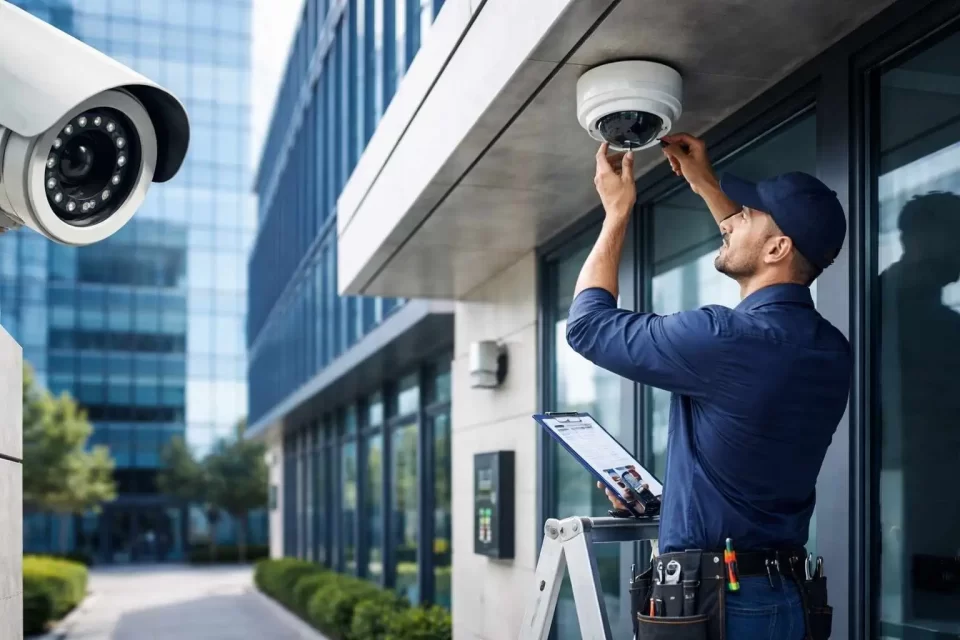
Modern video surveillance provides live monitoring, forensic evidence, and powerful business intelligence far beyond simple recording. High-definition IP cameras capture video footage, transmitting it to a Network Video Recorder (NVR) for storage or to the cloud. Cloud video storage enables remote monitoring and secure archiving of footage. Advanced systems feature analytics software for intelligent monitoring.
PTZ (Pan-Tilt-Zoom) cameras are specialized cameras that can move horizontally (pan), vertically (tilt), and zoom in on specific areas, providing flexible coverage for large spaces.
Key Business Applications
- Loss Prevention: Deterring and documenting theft, both internal and external, including employee theft.
- Operational Oversight: Monitoring customer flow, staff efficiency, and warehouse logistics.
- Liability Protection: Providing irrefutable evidence in case of accidents or false claims.
- Remote Management: Enabling owners to visually check on multiple locations from any device.
BGS Perspective
BGS focuses on right-sizing the solution. A convenience store needs different cameras than a manufacturing floor. They recommend a blend of camera types—dome cameras for general areas, PTZ for large spaces, license plate recognition for parking lots, and a mix of indoor and outdoor cameras for comprehensive coverage. Integration with other systems ensures that an alarm trigger automatically brings up the relevant camera feed. A video security system combines cameras, analytics, and monitoring for a complete, integrated security solution.
A wireless indoor camera is an easy-to-install option for small businesses or locations where running wires is difficult, providing flexibility without sacrificing security.
While video surveillance systems offer oversight and evidence, access control systems take security a step further by managing who can enter specific areas.
Access Control Systems
How They Work
Access control systems move beyond keys to intelligently manage entry to your building, specific rooms, or sensitive areas. These systems use credentials (key fobs, cards, mobile apps, or biometrics like fingerprints) to grant or deny access at electronic locks. A central software platform manages user permissions, creating detailed audit trails of every entry and exit.
Key Business Applications
- Eliminating Key Management: No more copying, losing, or retrieving physical keys.
- Time-Based Access: Restricting employee access to their specific shift hours.
- Sensitive Area Security: Limiting access to data centers, chemical storage, or financial offices to authorized personnel only. Some businesses may also employ security personnel to monitor access points as an added layer of protection.
- Instant Credential Revocation: Deactivating a lost fob or a terminated employee’s access instantly.
BGS Perspective
True security lies in layered access. BGS doesn’t just secure the front door—they design graduated zones, from the public lobby to employee-only areas to high-security rooms, ensuring a person can only enter spaces necessary for their role. Their systems also integrate with HR software for seamless onboarding and offboarding. Security experts at BGS Security Division play a key role in designing and customizing access control systems to meet the unique needs and compliance requirements of different industries.
While access control systems manage entry, intercom and entry systems enhance the security and professionalism of your first point of contact.
Intercom & Entry Systems
How They Work
Intercoms manage the critical first interaction at your property’s perimeter, enhancing security, convenience, and professionalism. Intercom systems are audio or video solutions designed for visitor identification and monitoring, providing a visual or audio record of entry and exit events. From simple audio doorbells to full video intercom stations, these systems allow communication between a visitor at an entrance (gate, door, parking) and an employee inside. Advanced systems integrate with access control to grant entry remotely.
Key Business Applications
- Secure Visitor Screening: Verifying identity before granting entry to a building or gated lot.
- Delivery Management: Instructing couriers where to leave packages without full access.
- Enhanced Safety for Isolated Areas: Providing a communication lifeline in parking garages or loading docks. Active guard outdoor protection can also be deployed to monitor and deter threats in large outdoor spaces such as parking lots or industrial areas.
BGS Perspective
An intercom is your virtual receptionist. BGS installs commercial-grade systems with high-quality audio and video that perform in all weather conditions. For offices, they integrate them with access control so an authorized visitor can be “buzzed in” directly after verification. For warehouses, they focus on robust, hands-free models for noisy loading bays.
While intercom and entry systems control visitor access, fire and life safety protection systems are essential for safeguarding lives and property from environmental hazards.
Fire & Life Safety Protection Systems
How They Work
These code-required systems are arguably the most critical, dedicated to saving lives and protecting property from fire, smoke, and other environmental hazards. This category includes fire alarm systems (smoke/heat detectors, pull stations, alarms), automatic sprinkler systems, and special hazard suppression.
Special hazard suppression refers to systems designed to protect areas with unique fire risks, such as commercial kitchens or server rooms, using specialized extinguishing agents.
Clean agent is a type of fire suppression material that extinguishes fires without leaving residue, making it ideal for sensitive environments like data centers.
Addressable fire panels are advanced fire alarm control panels that can pinpoint the exact location of an activated device (such as a smoke detector), rather than just identifying a general zone.
Key Business Applications
- Early Warning & Evacuation: Detecting smoke or heat in its incipient stage to initiate safe evacuation.
- Automatic Fire Suppression: Sprinklers activate to control or extinguish a fire before firefighters arrive.
- Code Compliance & Insurance: Meeting local fire codes and maintaining necessary insurance coverage.
- 24/7 Monitoring: Ensuring fire department dispatch even when the building is empty.
BGS Perspective
Compliance is the minimum; reliability is everything. BGS doesn’t just install to code—they design for maximum uptime and early detection. They use intelligent, addressable fire panels that tell you the exact location of an alarm, not just the zone. Their monitoring ties fire alarms directly to the local fire department and key personnel, ensuring the fastest possible response to save lives and minimize property damage.
With all five system types in place, the next step is ensuring they are monitored and managed for rapid response when it matters most.
Monitoring and Response: Ensuring Rapid Action When It Matters
Professional Monitoring Services
In today’s fast-paced business environment, having a business security system that delivers rapid, reliable response is non-negotiable. Professional monitoring services involve dedicated experts who keep watch over your property 24/7 from a secure monitoring center. When an alarm is triggered or a security breach is detected, these professionals can immediately verify the threat and dispatch emergency responders, such as police or fire services, to your location.
This level of vigilance is especially critical for small businesses and organizations with valuable assets, sensitive data, or after-hours operations.
Remote Monitoring and Automation
Remote monitoring and smart automation features have revolutionized business security. With advanced technology, business owners can access live video surveillance, receive instant alerts, and control access points from anywhere using their smartphone or computer. Smart locks and electronic access controls allow for secure, flexible entry management, while video monitoring provides real-time oversight of business operations—helping deter theft, prevent employee misconduct, and ensure safety.
Types of Security Systems
Choosing the right security system depends on your unique needs. There are various types of security systems available, including wired, wireless, and hybrid solutions. Each offers different advantages in terms of scalability, installation, and integration.
Professional installation ensures that every component—from intrusion detection to video surveillance—is optimized for your facility, while professional monitoring adds an essential layer of comprehensive security.
Cost Considerations
Business security system cost is influenced by several factors, including:
- The number and type of security cameras
- Access control devices
- Alarm systems
- The level of monitoring service required
Investing in a reliable security system is a proactive step that can save your business from costly losses, downtime, and reputational damage caused by security breaches.
Cybersecurity Protection
Modern security systems also address evolving threats, including cybersecurity protection. As more security equipment becomes networked, safeguarding your business against digital intrusions is just as important as physical security. Look for providers who offer personalized solutions, advanced technology, and robust cybersecurity features to ensure your business is protected on all fronts.
With these systems in place and monitored, integration becomes the next step for comprehensive protection.
Building Your Integrated Security Ecosystem
Individually, these systems are powerful tools. But when integrated, they become a true force multiplier. Imagine a scenario where a forced door triggers the alarm, which automatically directs nearby cameras to record and display the breach, while the access control system seals off internal corridors. This is the modern standard of protection.
When selecting the right system for your business, it’s important to evaluate security features, security sensors, and monitoring plans that fit your operational needs. Whether you require a commercial security system for a large facility or small business security systems for a smaller operation, your choice should be tailored to your specific requirements.
The cost and effectiveness of a business security system depends on factors such as the size of your business, risk profile, and the features included. Monitoring costs can vary based on the level of service and system complexity, with modern systems offering advanced security features and remote management through mobile apps. Consulting with security experts ensures you design a system for your business that addresses your unique security concerns and operational requirements.
Choosing the right combination depends entirely on your business’s unique risk profile, size, and industry.
Ready to build your tailored security ecosystem? Here’s how to get started:
- Schedule a professional assessment.
- Analyze your vulnerabilities and operational needs.
- Design a layered solution with expert guidance.
Schedule a free, no-obligation security consultation with a BGS Security Division expert today. We’ll analyze your vulnerabilities and design a layered solution that gives you true peace of mind.